When Clyde Tombaugh discovered Pluto in 1930, astronomers
assumed it was a lone oddball at the edge of the solar system. But in the late
20th century, scientists realized that Pluto was just the tip of the iceberg —
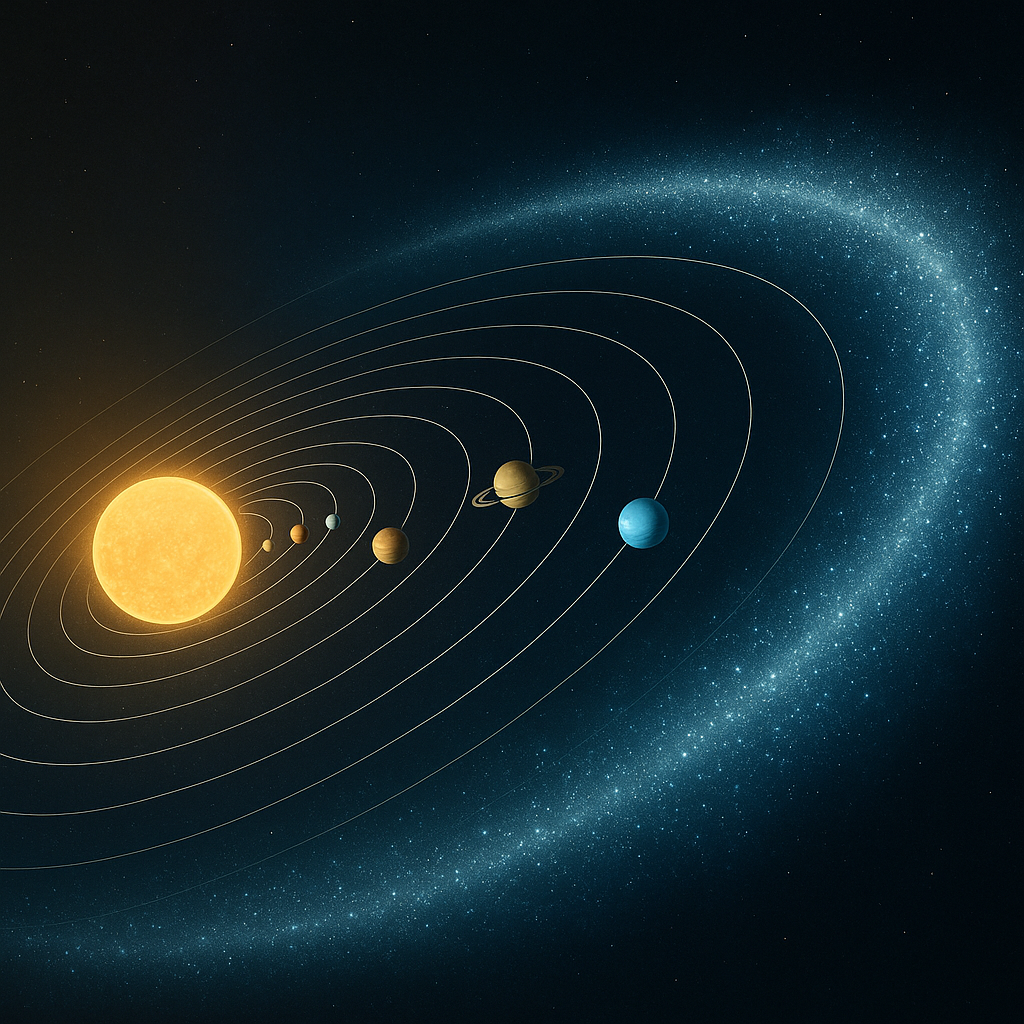
literally. Beyond Neptune stretches the Kuiper Belt, a vast, icy
realm filled with frozen remnants from the solar system’s birth.
What Is the Kuiper Belt?
The Kuiper Belt is a doughnut-shaped region of icy
bodies extending from about 30 to 50 astronomical units (AU) from
the Sun. (1 AU is the distance between Earth and the Sun.)
It is similar to the Main Asteroid Belt but far larger and
colder. Instead of rocky debris, it contains icy planetesimals —
small worlds made of frozen water, methane, ammonia, and other volatile
compounds.
Astronomers estimate there may be hundreds of
thousands of Kuiper Belt Objects (KBOs) larger than 100 km across,
plus countless smaller ones.
Famous Residents
The Kuiper Belt is home to several remarkable dwarf planets
and icy bodies:
A Source of Comets
Many short-period comets (those with orbits
less than 200 years) originate in the Kuiper Belt. When their orbits are nudged
inward by gravitational interactions, these icy bodies become comets, producing
tails when heated by the Sun.
Halley’s Comet, for example, likely comes from the scattered
inner regions of the Kuiper Belt.
Exploration: The New Horizons Mission
NASA’s New Horizons mission revolutionized
our understanding of the Kuiper Belt:
New Horizons showed that the Kuiper Belt is not a static
graveyard but a region full of surprises.
Why the Kuiper Belt Matters
The Kuiper Belt is scientifically important because:
Some astronomers even suspect a hidden “Planet Nine” may
lurk beyond the Kuiper Belt, its gravity shaping the orbits of distant KBOs.
Final Thought
The Kuiper Belt is not just Pluto’s home — it is a cosmic
frontier, filled with icy worlds, dwarf planets, and comets that preserve
the earliest history of the solar system. As missions like New Horizons continue
to push the boundaries, we are only beginning to uncover the secrets of this
frozen realm.
Just as the Main Asteroid Belt is a rocky archive,
the Kuiper Belt is the icy library of the solar system’s past. And
together, they remind us that the edges of our solar system hold just as much
wonder as its center.