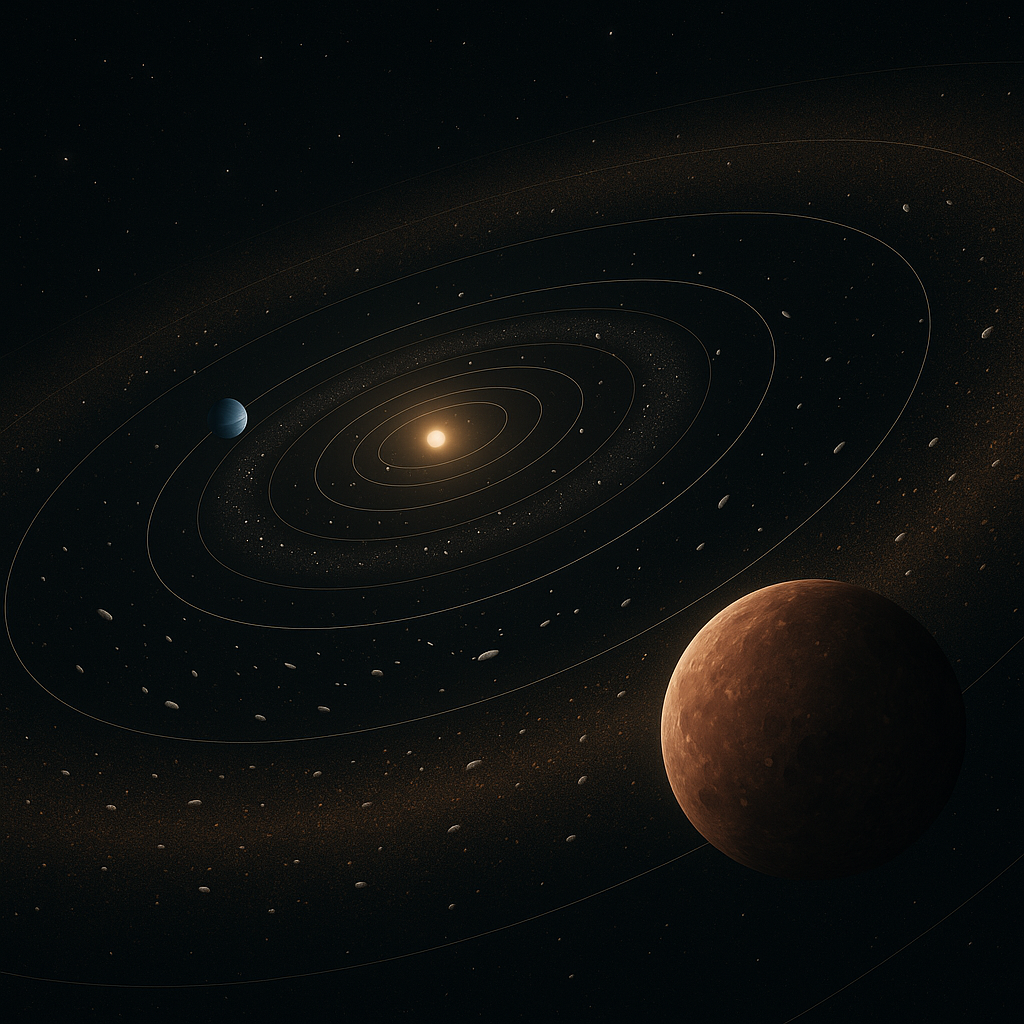
If the Kuiper Belt is a frozen ring around the Sun, then
the Scattered Disk is its chaotic cousin. This distant region,
lying beyond the Kuiper Belt, is populated by icy worlds on highly
stretched, tilted, and unstable orbits. These objects were once part of the
solar system’s orderly outer zone, but powerful gravitational kicks from
Neptune flung them into eccentric paths that carry them far from the Sun.
The Scattered Disk is more than just a curiosity — it may be
the bridge between the Kuiper Belt and the Oort Cloud, and a key to
unlocking the story of how our solar system evolved.
Where Is the Scattered Disk?
The Scattered Disk begins just beyond the Kuiper Belt,
around 50 astronomical units (AU) from the Sun, and extends
outward for hundreds of AU.
Unlike the relatively flat and stable Kuiper Belt, scattered
disk objects (SDOs) have:
Famous Residents of the Scattered Disk
Several well-known and mysterious worlds belong to this
population:
How Did It Form?
The Scattered Disk owes its existence to the migration
of the giant planets — especially Neptune. Billions of years ago, as
the solar system was forming:
This chaotic scattering process preserved a record of the
solar system’s turbulent early history.
Comet Connections
Many long-period comets (those with orbits
of hundreds or thousands of years) are believed to originate in the Scattered
Disk. These icy bodies can be nudged inward, passing close to the Sun and
producing spectacular comet tails visible from Earth.
The Scattered Disk is therefore a comet nursery —
one that continues to deliver icy messengers to the inner solar system.
Why It Matters
Studying the Scattered Disk is crucial because it helps
astronomers:
Final Thought
The Scattered Disk is the solar system’s wild
frontier — a region where icy worlds wander on unpredictable orbits,
shaped by ancient gravitational battles. It connects the orderly Kuiper Belt to
the mysterious Oort Cloud and offers a glimpse into the chaotic past of our
solar system.
As new telescopes and surveys push deeper into space, we are
beginning to discover more of these distant wanderers. Each one is a frozen
relic, carrying secrets from the solar system’s turbulent youth and
pointing us toward mysteries yet to be solved.