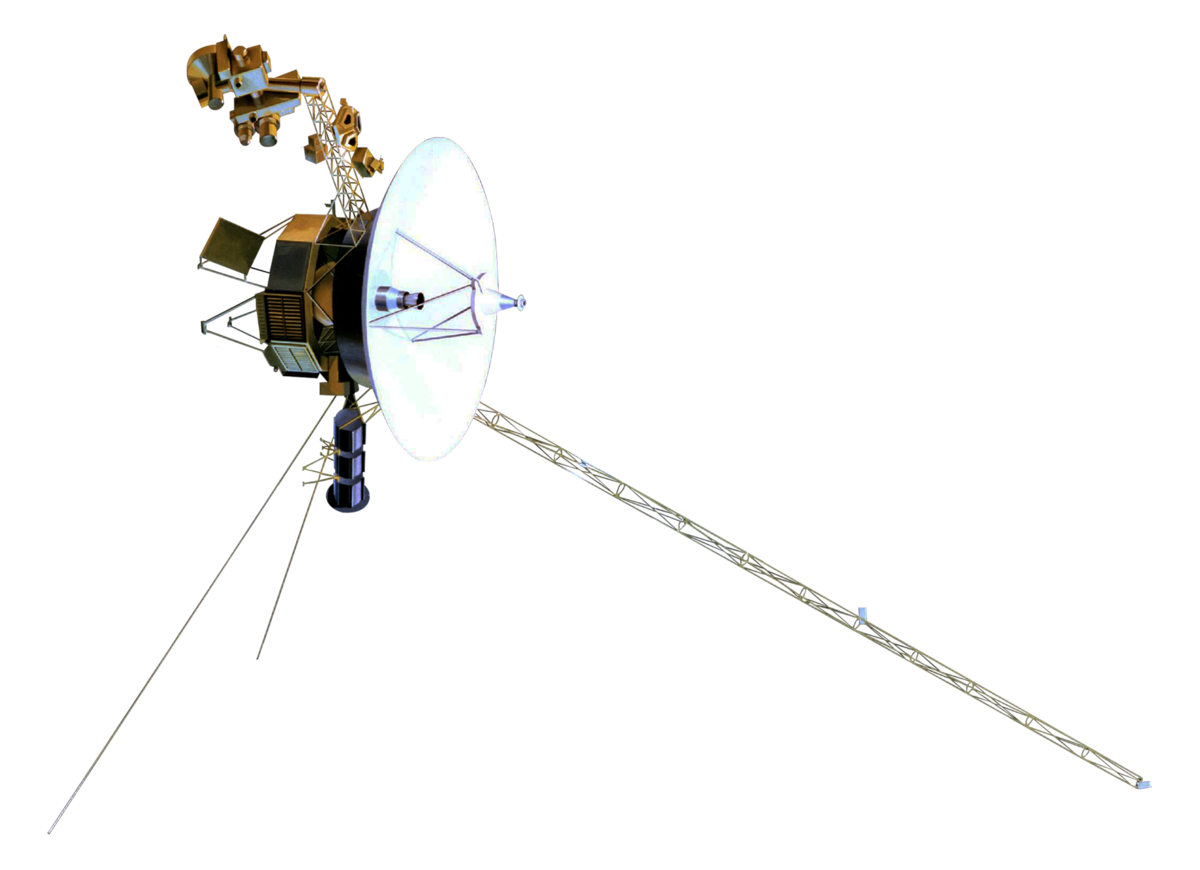
In the vast silence beyond the planets, one tiny spacecraft
continues its mission—a 1970s probe that has become the most distant human-made
object in existence: Voyager 1.
 Launched in
1977: The Start of a Grand Journey
Launched in
1977: The Start of a Grand Journey
Voyager 1 was launched by NASA on September 5, 1977,
just 16 days after its twin, Voyager 2. Though launched second, Voyager 1 took
a faster route and overtook its sibling en route to Jupiter and Saturn.
Originally part of NASA’s Mariner program,
Voyager 1 was designed for a once-in-176-years planetary alignment that allowed
gravity assist flybys of the outer planets. This mission became known as
the Grand Tour.
 The Grand
Tour: Jupiter and Saturn
The Grand
Tour: Jupiter and Saturn
Voyager 1's planetary mission yielded some of the most
iconic space discoveries of the 20th century:
After Saturn, Voyager 1 was steered toward the outer edge of
the Solar System, ending its planetary tour.
 Entering
Interstellar Space
Entering
Interstellar Space
On August 25, 2012, Voyager 1 crossed the heliopause,
the boundary where the Sun’s solar wind gives way to the pressure of
interstellar space. It became the first spacecraft to enter
interstellar space.
It now provides direct measurements of the interstellar
medium—cosmic rays, plasma waves, and magnetic fields far beyond the
planets—offering data never before captured by a spacecraft.
 Where Is
Voyager 1 Now?
Where Is
Voyager 1 Now?
As of May 2025, Voyager 1 is over 24
billion kilometers (15 billion miles) from Earth. Its radio signal,
traveling at the speed of light, takes about 22.5 hours to
reach Earth.
Despite this immense distance, Voyager 1 is still
operational, although with diminishing power. Its Radioisotope
Thermoelectric Generator (RTG) is expected to provide enough power
until around 2030.
 The
2024–2025 Anomaly: A Troubleshooting Triumph
The
2024–2025 Anomaly: A Troubleshooting Triumph
In late 2023, Voyager 1 began transmitting corrupted
telemetry data—signals arrived, but data were unintelligible. Engineers
suspected a fault in the Flight Data System (FDS).
By April 2025, NASA's Jet Propulsion Laboratory
(JPL) successfully rerouted commands to bypass the damaged memory
segment, restoring communication—a testament to the ingenuity of a team
working with a 46-year-old spacecraft over 24 billion km away.
This incident became known in popular discussions as
the "Voyager 1 paradox", though not a scientific paradox,
but rather an engineering mystery overcome through persistence.
 The Golden
Record: Earth’s Message in a Bottle
The Golden
Record: Earth’s Message in a Bottle
Voyager 1 carries a 12-inch gold-plated copper disc known
as the Golden Record, curated by a team led by Carl Sagan.
It contains:
It’s a message to any extraterrestrial civilization that
might one day find it—an echo of Earth across cosmic time.
 A Legacy of
Exploration and Hope
A Legacy of
Exploration and Hope
Voyager 1 is more than just a spacecraft. It represents:
In Carl Sagan’s words:
“This distant spacecraft will be encountered and the record
played only if there are advanced spacefaring civilizations in interstellar
space. But the launching of this ‘bottle into the cosmic ocean’ says something
very hopeful about life on this planet.”
 Fast Facts
|
Fact |
Details |
|
Launch Date |
September 5, 1977 |
|
Jupiter Flyby |
March 5, 1979 |
|
Saturn Flyby |
November 12, 1980 |
|
Entered Interstellar Space |
August 25, 2012 |
|
Current Distance (May 2025) |
~24.3 billion km (15.1 billion mi) |
|
Signal Time to Earth |
~22.5 hours |
|
Speed |
~61,000 km/h (38,000 mph) |
|
Expected Power Loss |
~2030 |
|
Mission Duration |
47+ years and ongoing |
 Final Thought
Voyager 1 is humanity’s farthest and most
enduring emissary. Long after it falls silent, it will drift through the
galaxy—an artifact of Earth’s scientific age and a tribute to our desire to
understand the cosmos.